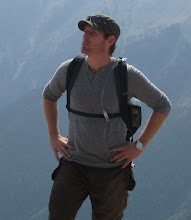
Two links to two new albums of my recent Israel trip. It was short, but filled with all sorts of religious experience-ness, yeah...
http://www.facebook.com/album.php?aid=2072743&l=445ea&id=26310454
http://www.facebook.com/album.php?aid=2072790&l=398fb&id=26310454
Just cut and paste in your address bar, people.
Sunday, June 1, 2008


Saturday, May 24, 2008
Jesus Christ vs. Nancy Pelosi

As I walked through the dark corridor in Jerusalem's Church of the Holy Sepulchre, which houses the places where Jesus was crucified and entombed, I saw several stern-faced men in suits walking towards me. As they turned to walk down the stairs to the Saint Helena Chapel, footsteps echoing off the stone walls, a dignified, older woman emerged from behind them. She was listening intently to a monk cum tour-guide, and while my friends stuttered in their efforts to place her, her face immediately registered in my mind.
"Holy crap, it's Nancy Pelosi!" I whispered.
I've had kind of a weird older-woman crush on Nancy for about two years now. I was ecstatic at my golden opportunity to make an impression, take a chance, get her number... I forgot where I was going and what I'd come to Jerusalem for, and followed her down the stairs to the chapel. We waited several minutes for her tour to take her back up the stairs. My friend snapped a few odd-looking pictures of my head in the foreground and Ms. Pelosi's hair in the background. I only wanted to shake her hand, and my waiting paid off. She and her entourage took to the stairs, and I asked an aid if I could shake her hand. She heard me ask, turned her head and smiled wide. I reached my hand over to her, shook hers and said, "Ms. Pelosi, I just want to shake your hand and say that I respect you very much." She thanked me and asked my friends and me where we were from. We told her, and she thanked us again and moved on.
This is the first famous person I've met. Unfortunately, she didn't offer me a job or even her phone number, so I decided that Jesus, at that moment at least, would take precedent over Nancy Pelosi. I didn't follow her, but rather continued with my tour of the church. My thoughts for the rest of the day, however, were with Nancy, not Jesus. Sorry JC.
Tuesday, May 13, 2008
If I felt like my life was worth writing about, I'd be updating this thing way more than I have been. Actually, I won't even venture to say that I'm updating it now. It's more of a courtesy message, because I can't help but feel guilty that I'm keeping friends and family so in the dark.
I can't stand reading those blog messages that detail people's every boring minute, every trivial purchase, every uneventful venture out of the county (that's county, not country). Unless you can be funny about it, then I'll read it. But I don't have the talent to make a trip to the local Islamic supermarket seem even remotely interesting. Maybe if the cashiers there would do something more entertaining than laugh their asses off whenever I try to speak Turkish with them, I might have some decent material. I'm not even initiating the conversation with them, by the way. They ask me a question, I respond, they laugh. Real nice.
Well anyway, here's a bit of news for ya: I'm going to Israel this Saturday. Some friends are coming from the States to visit me, and we're all gonna go get a look at land-apartheid first hand. Maybe I shouldn't say that. The Israelis may be reading my blog. Anyway, it will be amazing. I'll upload some pictures when I get back and maybe I'll have a story or two. Shalom (that was so cliche, but I couldn't resist).
I can't stand reading those blog messages that detail people's every boring minute, every trivial purchase, every uneventful venture out of the county (that's county, not country). Unless you can be funny about it, then I'll read it. But I don't have the talent to make a trip to the local Islamic supermarket seem even remotely interesting. Maybe if the cashiers there would do something more entertaining than laugh their asses off whenever I try to speak Turkish with them, I might have some decent material. I'm not even initiating the conversation with them, by the way. They ask me a question, I respond, they laugh. Real nice.
Well anyway, here's a bit of news for ya: I'm going to Israel this Saturday. Some friends are coming from the States to visit me, and we're all gonna go get a look at land-apartheid first hand. Maybe I shouldn't say that. The Israelis may be reading my blog. Anyway, it will be amazing. I'll upload some pictures when I get back and maybe I'll have a story or two. Shalom (that was so cliche, but I couldn't resist).
Monday, March 10, 2008
Holy Crap, I Am So Happy

Latest results from the Turkey Happiness Survey. Click here to view it. It's actually quite revealing, and I can't say I was all that surprised about some (but not all) of the results.
A Word Is Worth 1000 Pictures

There's something mildly appalling about the newspapers of some of the countries I've visited. Not all, but many. Spain's was good, especially El Pais-those one euro weekly Spanish classic from the likes of Miguel de Unamuno or Lorca made a loyal reader out of me-and even Mexico's little papers weren't all that bad at conveying important information with a minimum in frills. But two nations stick in my mind as having the worst: Costa Rica and Turkey.
I'll be the first to admit that I love pictures. I'll draw them, stare at them, sometimes even cut them out and hang them on my mostly bare, white walls. But when they are so large and domineering that they micrify the actual newspaper text, that's when I begin to find them intolerable. The photos of these bogus newspapers aren't boring, that's for sure. Well, not at first. The cleavage of a female ass barely shrouded in an elastic string is what it is, and I'll gawk at it for just as long as the next guy. But when the center page of a country's most popular newspaper features 36 passport size photos of that very subject (as I saw in Costa Rica), not only does the aesthetic beauty of a shapely female butt lose its novelty, but it just wastes paper. At some juncture, you've got to ask yourself, are people really buying this boring shit every day?
Turkish newspapers are especially good at underestimating its readership's ability to synthesize ideas found in a lengthy text. The transmitting of information is largely left up to blocky graphics and cutouts of the human subjects the articles are about, creating the impression, for example, that a smiling, waving 50-foot Erdogan (Turkey's PM) from one article has unwittingly wondered beyond his boundaries and is about to trip over a pie chart and impale himself on a Dubai cityscape from another article. I wonder why Aydin Dogan, Turkey's biggest media baron, doesn't just fire the journalists, chuck all of the text, and turn his papers into veritable picture books with screaming headlines.
Sabah, which means morning, is Turkey's most popular legitimate newspaper (I use the word legitimate loosely) but it is by far the worst (can someone say correlation?). A typical front page might feature a combination of any of the following photos: the red, sweat-drenched face of a drunken celebrity; a surly looking Turkish soldier leaning on his gun (yes, the entire barrel is included); a prominent politician caught making a silly face; a mountainous pair of breasts crammed together in a skimpy, black braw like two jelly fish stuffed in a glass jar (I can't be overly indignant about that one, though).
On any given day, the front page of Sabah will feature no less than two large visual aids per story. A maximum, and I am not one known for hyperbole, of two small paragraphs can be found wedged between the photos. Take, for example, a story about the incursion of Turkish ground troops into Northern Iraq: an adulatory photo of a line of soldiers lying in snow, clad in white; another 50-foot Erdogan looking very, very severe; a bar graph showing the monthly increase of Turkish troops at the Iraq border. Oh, wait! I almost forgot about the text! Let's see...PKK, USA, terrorists are evil, everyone is pissed, got a little snippet of a quote from the PM. Next story!
Tonight I bought a copy of Sabah to see exactly what is the proportion of space occupied by graphics to space occupied by non-headline text. I focused my study on the front page and I found that in a total area of 2,128 square/cm, only 259 square/cm of space was occupied by non-headline text. One article about Talibani's recent visit to Turkey, a relatively historical event, received a scant 86 words. The continuation of the article on page 21 was a meager 100 words more. Granted the front page should be an eye popper, and the health and dating sections are nowhere near as skimpy. But the articles still lag far behind what you'd expect from, say, a U.S. News, let alone a NY Times.
The whole thing got me thinking: are Turks really that averse to reading, or does Turkish media, and the politicos who dictate to it much of what is reported, simply refuse to deign to thoroughly inform them? Or perhaps there is really no clue among the media as to what makes for good reportage. I, for one, believe that if you gave Turks a Turkish equivalent of the NY Times, they would eat it up. I mean, they would just tear through every political article, memorize the facts, and then go argue the thing with each other in the local tea house. They'd be like an under-nourished child who suddenly finds a plate of hot beans and soft bread sitting beneath his nose. I think the people are looking for substance, and the only way to fight the conspiracy theories, for example, that run rampant here is to provide not only accurate information, but enough of it! Maybe at some point it will change. For now I'll keep my newspapers in the bathroom in case I run out of toilet paper.
Sunday, March 2, 2008
Violent Fantasies
The kids outside my flat won't shut the hell up. They also enjoy throwing things. Snowballs, stones, soccerballs, even the occassional basketball, cumbersome but heavy enough to cause significant damage when thrown or kicked properly, glance and bounce off my windows at least once a week. They put a two meter crack in one girl's window last fall.
There are two of them, brothers, nearly indistinguishable. One is slightly fatter than the other and has a high voice, as distinct as a spoon stirring a glass of tea. I can here him all the way down the street. When I leave my apartment he calls out, "Abi! Abi!" in a desperate squeel. I don't understand the point of his addressing me with the respectful Turkish designation of "sir." I know he's cursing at me after he says hello. His friend several times told me in English that he "fucked my mother." I told him that that was nice because I fucked his too. I doubt he understood.
A week ago I caught the two brothers throwing a soccer ball against my windows. I waited by the door and came out when they were right in front. They bolted like cockroaches caught in the middle of the cellar floor when the light's turned on. I followed one into the supermarket and read him the riot act in what little Turkish I knew. Two days later, as I entered my flat they kicked their basketball at me, missing by a long shot but hitting the side of the building. I didn't get a hold of the ball, but my violent fantasies began.
This is how I envision it: I will get their ball-soccerball, basketball, whatever-while they are playing with it in front of my flat. I will hold it up for them for just a few seconds, like one might hold a trophy, admiring it, making sure they take in the perfect beauty of a round, inflatable object. I will then do one of two things. I will step up to the edge of the hill, down from which cars, shrubs, winding roads and paths, and ramshakle houses stand-wonderful nooks and crannies where one would never find a lost ball-and I will boot the ball with all my might. I will toss it before me, and just pound the hell out of it with one shot of my right foot. It will travel far, bounce off a roof, deflect off a tree branch, settle beneath a car. It will be a bitch to find. Option two, the more favored of the two: the boys will be bouncing the ball off my windows again. I'll come downstairs with a pear-knife in my back pocket and five lira in small change in the front. I will ask the brothers if I can play too. They will kick me the ball. Again, I will pick it up and hold it admiringly. I will then cradle the ball between my forearm and chest, remove my pear-knife and with one strong jab I'll pierce the ball, driving the blade in as far as it will go, right in front of their eyes. I'll throw the emasculated, airless piece of leather at their feet, not saying a word, and, like Michael Corleone in The Godfather II, I'll stick my hand in my pocket and I will remove the money (not bills though). From shoulder level I'll just drop it all on the street. Every little five and ten cent piece will gracefully fall from my palm and land on the ground, rolling around at their feet like little subservient dogs. I'll then turn around and walk back to my flat. And that will be the end of my problem with the brothers.
There are two of them, brothers, nearly indistinguishable. One is slightly fatter than the other and has a high voice, as distinct as a spoon stirring a glass of tea. I can here him all the way down the street. When I leave my apartment he calls out, "Abi! Abi!" in a desperate squeel. I don't understand the point of his addressing me with the respectful Turkish designation of "sir." I know he's cursing at me after he says hello. His friend several times told me in English that he "fucked my mother." I told him that that was nice because I fucked his too. I doubt he understood.
A week ago I caught the two brothers throwing a soccer ball against my windows. I waited by the door and came out when they were right in front. They bolted like cockroaches caught in the middle of the cellar floor when the light's turned on. I followed one into the supermarket and read him the riot act in what little Turkish I knew. Two days later, as I entered my flat they kicked their basketball at me, missing by a long shot but hitting the side of the building. I didn't get a hold of the ball, but my violent fantasies began.
This is how I envision it: I will get their ball-soccerball, basketball, whatever-while they are playing with it in front of my flat. I will hold it up for them for just a few seconds, like one might hold a trophy, admiring it, making sure they take in the perfect beauty of a round, inflatable object. I will then do one of two things. I will step up to the edge of the hill, down from which cars, shrubs, winding roads and paths, and ramshakle houses stand-wonderful nooks and crannies where one would never find a lost ball-and I will boot the ball with all my might. I will toss it before me, and just pound the hell out of it with one shot of my right foot. It will travel far, bounce off a roof, deflect off a tree branch, settle beneath a car. It will be a bitch to find. Option two, the more favored of the two: the boys will be bouncing the ball off my windows again. I'll come downstairs with a pear-knife in my back pocket and five lira in small change in the front. I will ask the brothers if I can play too. They will kick me the ball. Again, I will pick it up and hold it admiringly. I will then cradle the ball between my forearm and chest, remove my pear-knife and with one strong jab I'll pierce the ball, driving the blade in as far as it will go, right in front of their eyes. I'll throw the emasculated, airless piece of leather at their feet, not saying a word, and, like Michael Corleone in The Godfather II, I'll stick my hand in my pocket and I will remove the money (not bills though). From shoulder level I'll just drop it all on the street. Every little five and ten cent piece will gracefully fall from my palm and land on the ground, rolling around at their feet like little subservient dogs. I'll then turn around and walk back to my flat. And that will be the end of my problem with the brothers.
Saturday, February 9, 2008
The Headscarf
Today the Turkish parliament approved a constitutional amendment that relaxes the ban on the wearing of the Islamic headscarf. Specifically, it allows women to leave their headscarves on upon entering university campuses and classes. Ever since I learned of this law, I've strongly believed that it should be overturned. The newspapers quote some Turkish lawmakers who believe, however, that the relaxing of the headscarf ban will plunge universities into "chaos and lead to the disintegration of the state." Such hyperbolic rhetoric, mind you, is typical of nationalist and secular Turks, especially many of the elite do-nothings in parliament. For the entire life of Modern Turkey, power has been in the hands of the secular elite, and now they're scared shitless of permanently losing that power to the populist, mildly Islamic party occupying the prime ministerial and presidential positions, as well as holding an overwhelming majority in parliament. In spite of, or perhaps I could say because of, their Islamic roots, they have enacted changes that deal fairly with both the secular and Islamic population. I believe it is a victory for democracy and the freedom to practice one's religion in a non-confrontational manner. Nonetheless, many see the headscarf as just that-political confrontation. To some it is a symbol of a perceived threat of Sharia law, and many secular Turks are so paranoid that they've declared, just as they did in the mid 90's, that Turkey has begun its slide down the same slippery slope that doomed Iran to Islamic theocracy.
I couldn't disagree more. I recently read a book called Star and Crescent, by a journalist named Steven Kinzer. In one chapter he talks about the headscarf ban, and he interviews some female PhD candidates who had dropped out of university because they could no longer go to classes wearing their very customary and very meaningful headscarves. He remarks that he thinks Ataturk would much rather see young, devout Muslim women clamoring for PhD's than clamoring at the nearby McDonalds for lunch because they can't go to class. Ataturk, in fact, wanted the uneducated Muslim population to advance, which begs two questions: (1)Why, in an effort to advance a nation, should a large amount of its population be barred from higher education because of a simple piece of cloth, and (2)If those students choose to remove their headscarves, how does such an action at the level of higher education teach a nation acceptance of religious and cultural diversity, a cornerstone of every successful, modern democracy?
An anecdote: tonight I went to Starbucks in Ortakoy to study my Turkish. There two covered girls came in, which happens far less than it should. In fact, I couldn't for the life of me remember when I'd last seen such an occurence. I watched them from my seat above, and judging by their wide smiles and giddy chit chat, I decided they had come out for a celebratory frappuccino. Their faces were filled with hope, with vindication, with a new sense of possibility. They began taking pictures of each other on their cell phones, leaning their covered heads over the screen, laughing and pointing. I thought about how common the headscarf was during my two years at CUNY Hunter in New York, how nobody judged another for his or her religious devotion. In fact, Hunter and the entire CUNY system thrives because of this religious and political harmony. I'm happy to see that Turkey seems to be coming around, however small those steps towards progress and tolerance are.
I couldn't disagree more. I recently read a book called Star and Crescent, by a journalist named Steven Kinzer. In one chapter he talks about the headscarf ban, and he interviews some female PhD candidates who had dropped out of university because they could no longer go to classes wearing their very customary and very meaningful headscarves. He remarks that he thinks Ataturk would much rather see young, devout Muslim women clamoring for PhD's than clamoring at the nearby McDonalds for lunch because they can't go to class. Ataturk, in fact, wanted the uneducated Muslim population to advance, which begs two questions: (1)Why, in an effort to advance a nation, should a large amount of its population be barred from higher education because of a simple piece of cloth, and (2)If those students choose to remove their headscarves, how does such an action at the level of higher education teach a nation acceptance of religious and cultural diversity, a cornerstone of every successful, modern democracy?
An anecdote: tonight I went to Starbucks in Ortakoy to study my Turkish. There two covered girls came in, which happens far less than it should. In fact, I couldn't for the life of me remember when I'd last seen such an occurence. I watched them from my seat above, and judging by their wide smiles and giddy chit chat, I decided they had come out for a celebratory frappuccino. Their faces were filled with hope, with vindication, with a new sense of possibility. They began taking pictures of each other on their cell phones, leaning their covered heads over the screen, laughing and pointing. I thought about how common the headscarf was during my two years at CUNY Hunter in New York, how nobody judged another for his or her religious devotion. In fact, Hunter and the entire CUNY system thrives because of this religious and political harmony. I'm happy to see that Turkey seems to be coming around, however small those steps towards progress and tolerance are.
Subscribe to:
Posts (Atom)